Grow it. · PickleRadio
Why cucumber seeds are not germinating
An empty pot does not prove the seed is dead. Check time, warmth and moisture first; if shoots appeared and collapsed, follow the seedling checks instead.
In this guide9 sections
First, decide which problem you have
If nothing has appeared, leave the seed undisturbed while you check the sowing date, temperature and moisture. Buying another packet before fixing a cold or waterlogged pot can leave you with the same result.
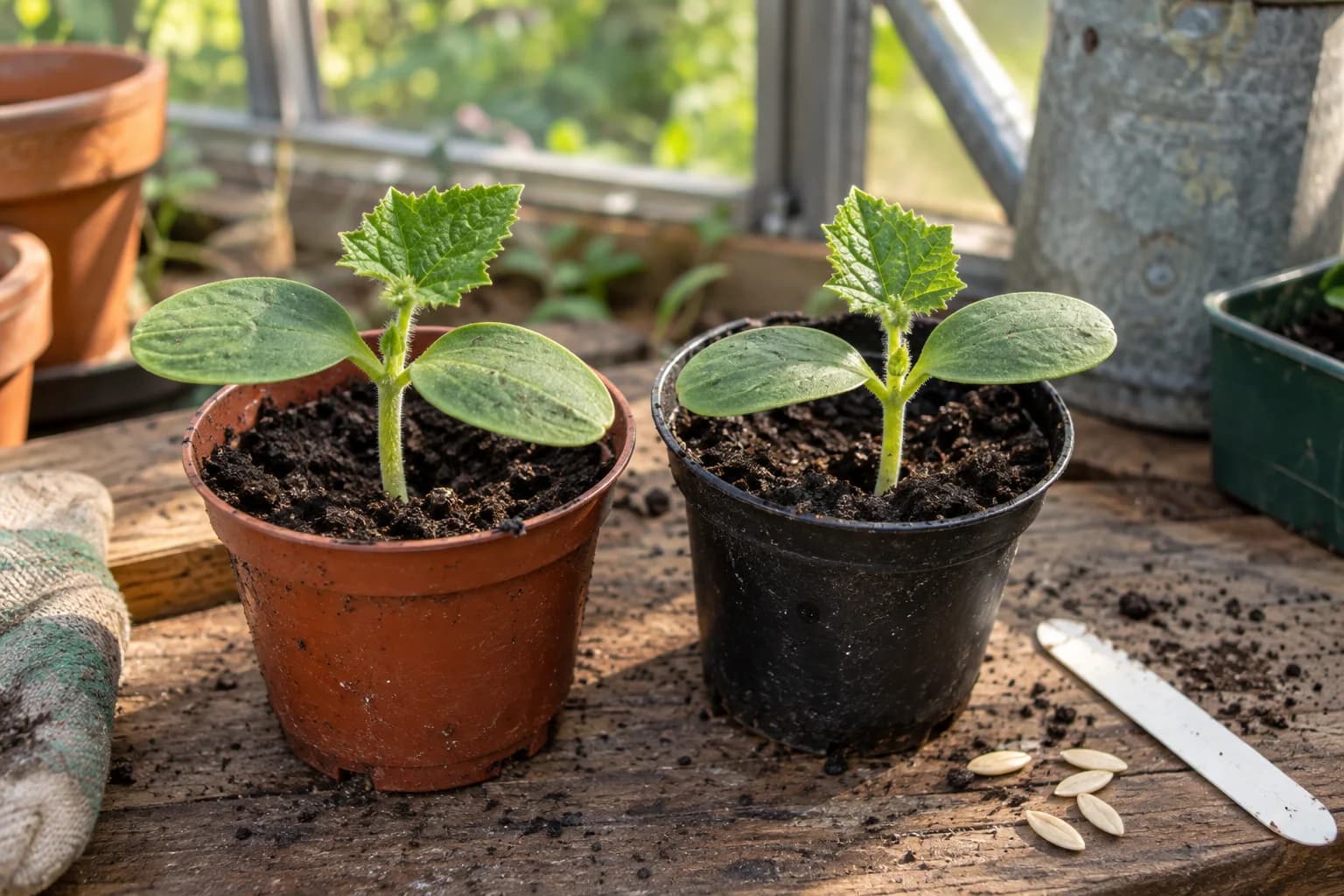
If a shoot came up and then fell over, the seed did germinate. Look at the collapsed-seedling section below; waiting longer for germination will not address that problem.
Keep the packet and your sowing date beside you. A short record of what you observe will help more than making several changes at once and trying to remember which one mattered.
Check the temperature where the seed is sitting
Utah State University’s cucumber guidance gives germination at roughly 5–10 days in temperatures of 65–85°F, about 18–29°C. Treat that as a reference under suitable conditions. It is not a deadline proving a seed dead on day eleven.
Measure the mix near seed depth, away from the seed itself. Minnesota Extension notes that potting mix can be around 5°F, roughly 3°C, cooler than the room. A bright windowsill can also be cold overnight and hot later in the day. One room-temperature reading can miss both changes.
If the mix is too cool, move the pot to a steadier suitable location or use a seed-starting heat mat according to its instructions. Take another reading after the change. Turning a heater to maximum is not a germination plan.
A wet surface can hide dry mix
Check the mix below the surface at the edge of the pot. Does it feel damp, dry or saturated? Keep away from the seed so that checking conditions does not become repeated excavation.
Minnesota’s seed-starting advice explains why surface misting may leave the mix underneath dry. If that is the problem, water gently through the mix and allow excess to drain. If the pot is staying saturated, check the drainage and standing water in the tray before adding more.
RHS sowing guidance aims for seed compost that stays moist without becoming waterlogged. Record the condition you find: “damp at seed depth” tells you more than “watered every morning”.
Do not add fertiliser as an attempt to make an empty pot sprout. Germinating seeds use stored reserves; extra feed does not replace suitable warmth and moisture.
Review the depth without digging everything up
Check the depth recommended on your packet and recall how you sowed. Utah State’s cucumber instructions use 1 inch, about 2.5 cm. A seed buried several inches down is a reason to review the sowing method; a correctly sown pot does not need to be emptied just to verify the measurement.
For a replacement sowing, use a separate labelled pot. Mark the intended depth on a pencil or ruler, make the hole, sow and cover gently. Keeping the replacement separate lets you tell which conditions and sowing date produced a result.
Use a clean draining container and fresh seed-starting mix. The RHS indoor-sowing guide describes seed compost as fine and free-draining with few nutrients. A compacted or persistently wet medium is a setup problem worth changing before sacrificing more seed.
Shoots that collapse need a different response
A thin, water-soaked stem that gives way, or soft and discoloured seedlings, can indicate damping off. Minnesota’s damping-off guide links this problem with contaminated containers or growing medium and conditions that slow seedling growth, including cool, wet mix. It can also prevent shoots appearing in the first place.
These symptoms are clues, not identification of a particular pathogen. Do not assume every fallen seedling needs the same treatment, and do not reuse suspect mix for the next sowing.
- Restart with clean equipment and new mix; correct drainage, temperature and watering together.
- Keep notes on when the seedlings emerged and what happened before they fell over.
- For repeated losses, use the linked disease guide or seek local horticultural advice with photographs and your records.
Test a doubtful packet before filling more pots
For older seed or uncertain storage, Iowa State’s germination test uses at least 20 randomly selected seeds; larger samples are better. If your packet contains only a few, a smaller test can offer a clue, but it cannot give the same confidence.
- Count the seeds. Space them on damp paper towel and roll it so they remain separated.
- Put the roll in a labelled plastic bag and keep it at 70–80°F, about 21–27°C.
- Check after two or three days, then daily. Count a seed as germinated when a root or seed leaf emerges through the coat.
- When germination has stopped for a week, divide the number that sprouted by the number tested and multiply by 100.
Use the result to choose your next move
Sixteen sprouts from twenty seeds is 80% for that sample. It does not guarantee sixteen established plants from the next twenty: the seed test and life in a pot are different stages.
- Conditions suitable, sowing still within the expected window: keep checking moisture and temperature while you wait.
- A clear cold, dry or saturated-mix problem: correct that condition. Label a separate replacement sowing if you decide to restart.
- Very poor germination in a controlled test: obtaining fresh seed may be more useful than repeatedly relying on the doubtful packet.
Once a shoot appears, change the job
The RHS aftercare instructions advise removing the germination cover and giving emerged seedlings a bright position while maintaining moisture. You are now caring for a young plant, rather than trying to wake a seed.
Use the sowing guide for a clean restart or the pot-growing plan to prepare the plant’s eventual home. Changing variety only makes sense if its growing needs do not fit your space; use the variety comparison for that decision.
Sources
Checked 17 September 2026. The diagnostic order is our practical synthesis of Utah State’s cucumber guidance, Minnesota’s seed-starting advice, RHS indoor sowing, Minnesota’s damping-off guidance and Iowa State’s seed test.
The published temperature and timing ranges guide observation; they are not a fixed failure deadline or a diagnosis from a photograph.